|
General
Description |
|
 |
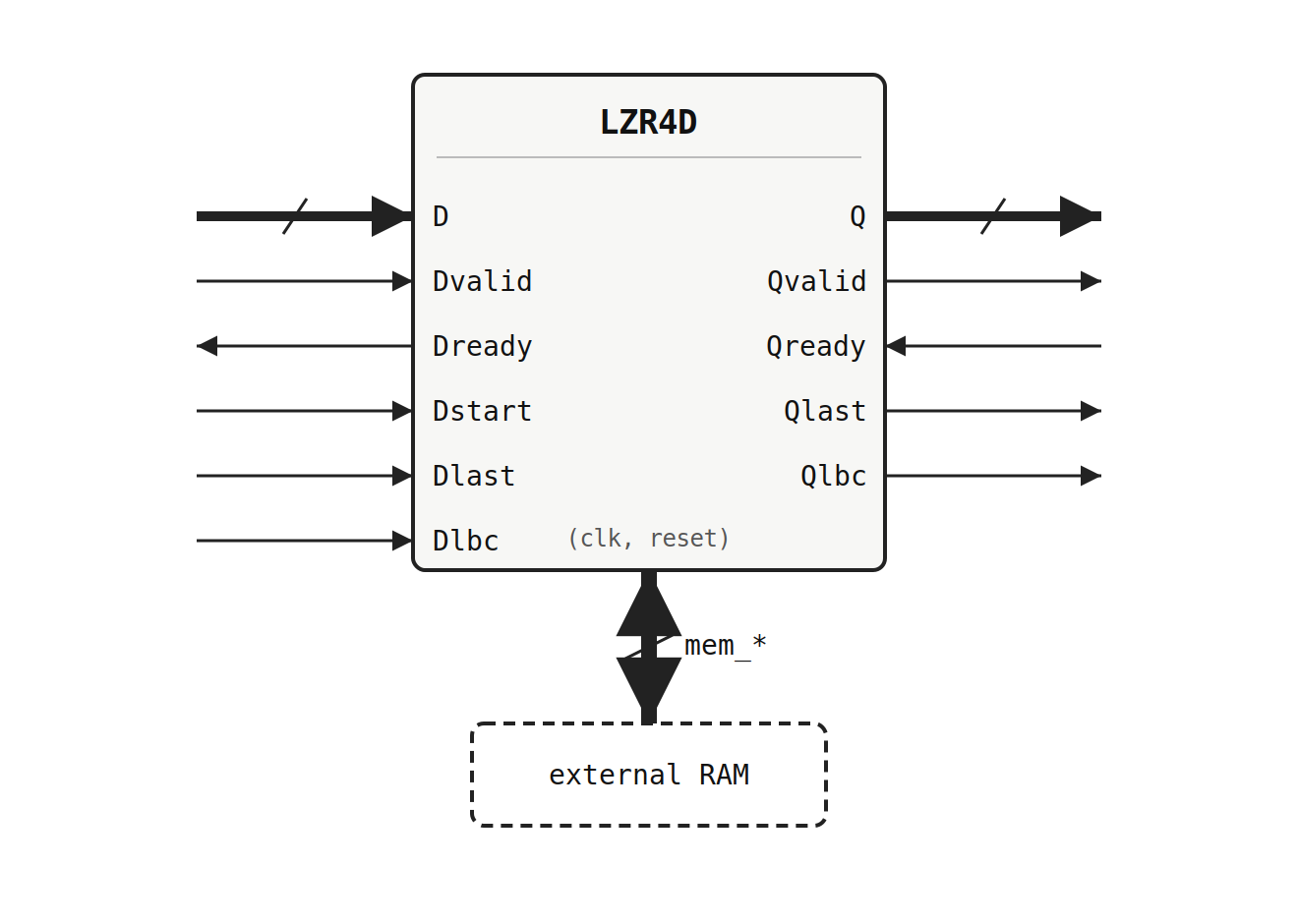
The LZR4D core implements lossless decompression of data compressed in the LZ4 format. |
|
Unlike conventional few-bytes-per-clock or token-per-clock designs, the LZR4D resolves multiple LZ4 sequences concurrently within a single decompression engine, sustaining an output rate of 256 bits (32 bytes) of decompressed data per clock cycle on a single compressed stream. At the multi-gigahertz clock rates of advanced process nodes, this corresponds to terabit-class decompression throughput in a single engine, with no need to split data into independently compressed blocks across an array of slower decompressors |
|
The core's decompression latency is below 30 clock cycles, which translates to an end-to-end decompression delay of 10 to 20 nanoseconds in advanced semiconductor nodes. This ultralow, deterministic latency allows the LZR4D to be placed directly in latency-critical data paths, such as compressed memory tiers, CXL-attached memory expanders, solid-state storage controllers, enterprise storage appliances, and in-network data processing, where the decompression step was previously a bottleneck. |
|
|
Symbol |
|
|
|
|
|
Key
Features |
|
| |
Single-engine architecture sustains 256 bits (32 bytes) of decompressed output per clock cycle |
|
Terabit-class decompression throughput at multi-gigahertz clock frequencies |
|
Ultralow, deterministic latency of under 30 clock cycles (10 to 20 ns in advanced semiconductor nodes) |
|
Resolves multiple LZ4 sequences concurrently within a single decompression engine |
|
No block-level stream splitting or arrays of parallel engines required |
|
Suitable for placement directly in latency-critical data paths |
|
|
Applications |
|
| |
Compressed memory tiers |
| |
CXL-attached memory expanders |
| |
Solid-state storage controllers |
| |
Enterprise storage appliances |
| |
In-network data processing |
| |
Network processors and memory subsystems |
|
|
|