RSA5X Core
Scalable RSA Exponentiation Accelerator Core |
|
| |
General Description
Rivest-Shamir-Adelman (RSA) is a public-key cryptographic technology that uses the mathematics of so called “finite field exponentiation”. The operations necessary for the RSA cannot be efficiently implemented on an embedded CPU, typically requiring many seconds of the CPU time for signature verification.
RSA5X implements by far the most time-consuming operation of the RSA cryptography: so called “exponentiation” to enable low-power operation of the battery-powered devices.
RSA5X also can perform addition and multiplication in the GF(p) and GF(2n) Galois fields.
The design is fully synchronous and available in multiple configurations varying in bus widths and throughput. |
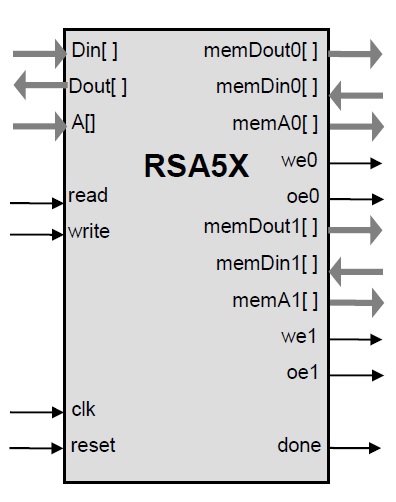
Symbol
|
Key Features
- Small size: RSA5X starts from less than 15K ASIC gates (size depends on the core configuration)
- Implements the computationally demanding parts of RSA public key cryptography for long life battery powered applications
- Support for RSA with programmable bit sizes
- Support for addition and multiplication in GF(p) and GF(2n) with programmable size
- Microprocessor-friendly interface using external dedicated memory for arguments, results, and scratch storage.
- An option to share the memory with the microprocessor is available.
- Test bench provided
|
Applications
- Secure communications systems
- Digital Rights Management (DRM) for battery powered electronics
- Digital Signature using Reversible Public Key (rDSA) standard ANSI X9.31
- Digital Signature Standard (DSS) FIPS-186
- PKCS RSA cryptography per RFC 2347
- High performance RSA accelerators
- Elliptic curve cryptography per FIPS 186-3, NIST SP800-56A, SEC 1 and SEC 2 standards
|
|
|
| |
Pin Description
| Name |
Type |
Description |
| CLK |
Input |
Core clock signal |
| reset |
Input |
HIGH level asynchronously resets the core |
| Din[ ] |
Input |
Core input data |
| Dout[ ] |
Output |
Core output data |
| A[ ] |
Input |
Address for the core memory or on-chip registers |
| read |
Input |
Core read request |
| write |
Input |
Core write request |
| memDin[ ] |
Input |
Dedicated external memory input data (two ports for dual-port memory) |
| memDout[ ] |
Output |
Dedicated external memory output data (two ports for dual-port memory) |
| memA[ ] |
Output |
Address for the dedicated external memory (two ports for dual-port memory) |
| oe |
Output |
Output enable request for the dedicated external memory (two pins for dual-port memory) |
| we |
Output |
Write enable for the dedicated external memory (two pins for dual-port memory) |
| done |
Output |
HIGH level indicates a completion of computation |
|
|
Function Description
The core implements the exponentiation operation of the RSA cryptography Q = Pk. The operands for the exponentiation: k and P as well as the modulus are programmed into the memory and the calculation is started. Once the operation is complete, the result Q can be read through the interface.
|
|
|
| |
Options
The core comes in a variety of options:
- Throughput options (-1, -2, -3, etc). Bigger number corresponds to higher throughput. RSA5X is designed for low-medium throughput (tens to hundreds or RSA operations per second)
- Multiplication option (CRT) provides an interface to accelerate the Chinese Remainder Theorem in hardware. Without this option, the default exponentiation-only (E) core still permits the use of the CRT, but requires some CPU support.
- Shared Memory (-SM) option permits sharing of the single-port memory with the CPU subsystem at the expense of lower performance.
|
|
|
| |
Export Permits
The core is subject to the US export regulations. See the IP Cores, Inc. licensing basics page, http://ipcores.com/exportinformation.htm, for links to US government sites and licensing details.
|
|
| |
Deliverables
HDL Source Licenses
- Synthesizable Verilog RTL source code
- Software modules for CRT support, as well as complete RSA, DH, and DSA implementation
- Verilog testbench (self-checking)
- Test harness and simulator for software modules
- Vectors for testbench and test harness
- Expected Results
- User Documentation
|
|
Netlist Licenses
- Post-synthesis EDIF
- testbench (self-checking)
- Vectors for the testbenches
- Expected results
|
|
|
| |
|